
Local business checklist
Local SEO Audit Checklist for Small Businesses: What to Check First
Use this local SEO audit checklist to review your business profile, website and inquiry journey. Record evidence, choose priorities and verify each fix.

Quick answer
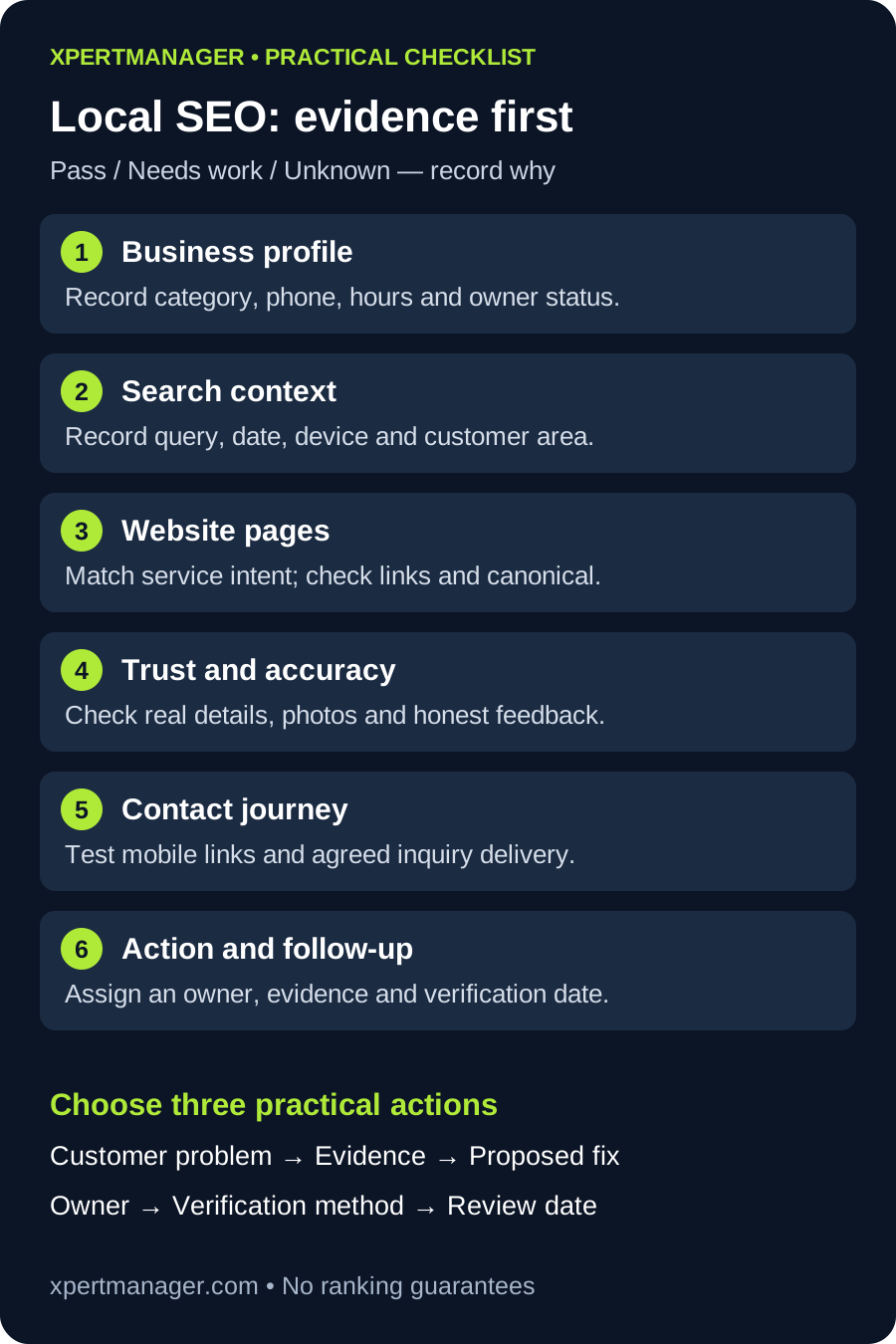
A useful local SEO audit checks whether customers can find accurate business information, understand your services and contact you. Record evidence for each finding, assign an owner and verify the fix. A score alone does not explain what to do next.
A simple way to approach it
- 01
Record the real business, service area and public profile details.
- 02
Compare an exact business-name search with a service search from a recorded location.
- 03
Review useful service pages and check website discovery, links and canonical settings.
- 04
Check accurate business information, authentic reviews and relevant photos.
- 05
Test the mobile contact journey and confirm delivery through an agreed test.
- 06
Assign three evidence-backed actions, with an owner and a verification date.
Start with a worksheet, not a list of warnings
Use this checklist for one real business and its genuine service area. For example, a plumbing company serving Austin could review its public profile, emergency-service page and quote form. This is an illustrative example, not a client result. The same approach works in other US cities, Canada, the UK and Australia; adapt addresses, opening hours and local terminology.
Create these columns: check, evidence, status, proposed action, owner and verification date. Use pass, needs work or unknown. Unknown means you have not verified something; it should not automatically reduce a business's score. Keep private account details out of reports intended for public sharing.
1. Check the business profile and who can manage it
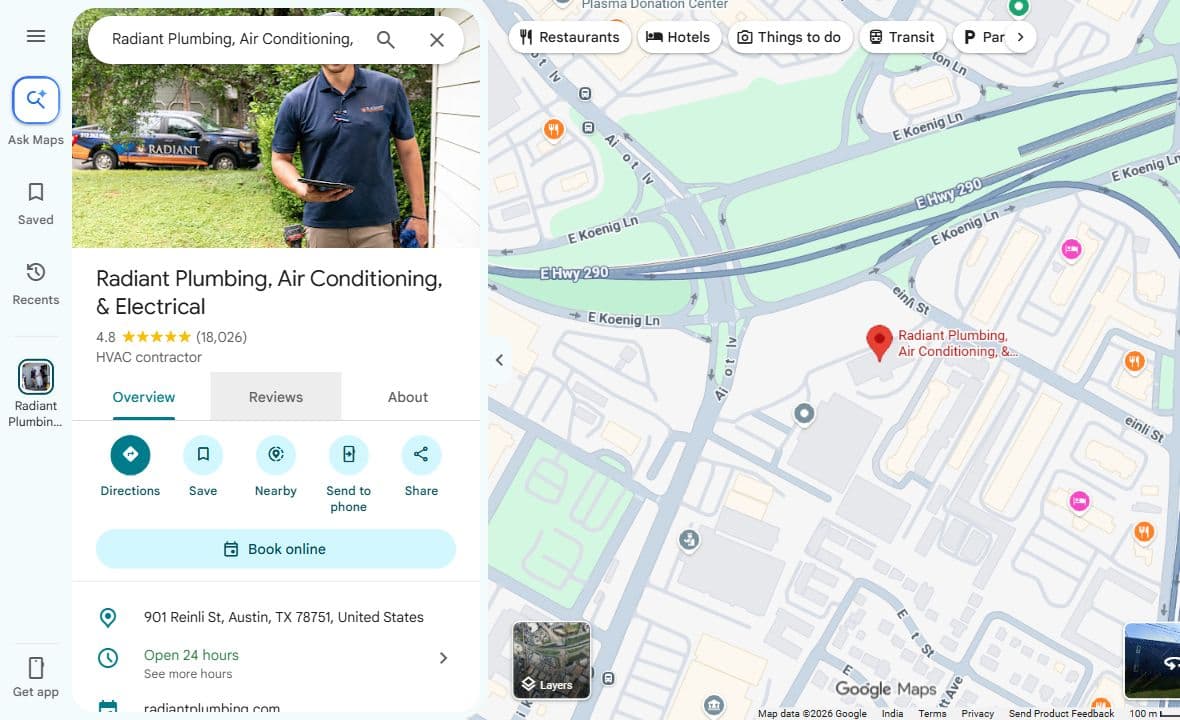
Search the exact business name and city. Record the public profile URL, category, phone, website and opening hours. Then ask the owner to check the managing account for verification or restriction messages. Public information cannot establish every private account status.
Google's business representation guidelines require information that reflects the real business. Check the name against actual branding and review whether the address or service-area setup matches how customers are served. Investigate suspected duplicate profiles before creating another one. An existing profile may already hold valuable reviews and ownership history.
2. Compare a brand search with a service search
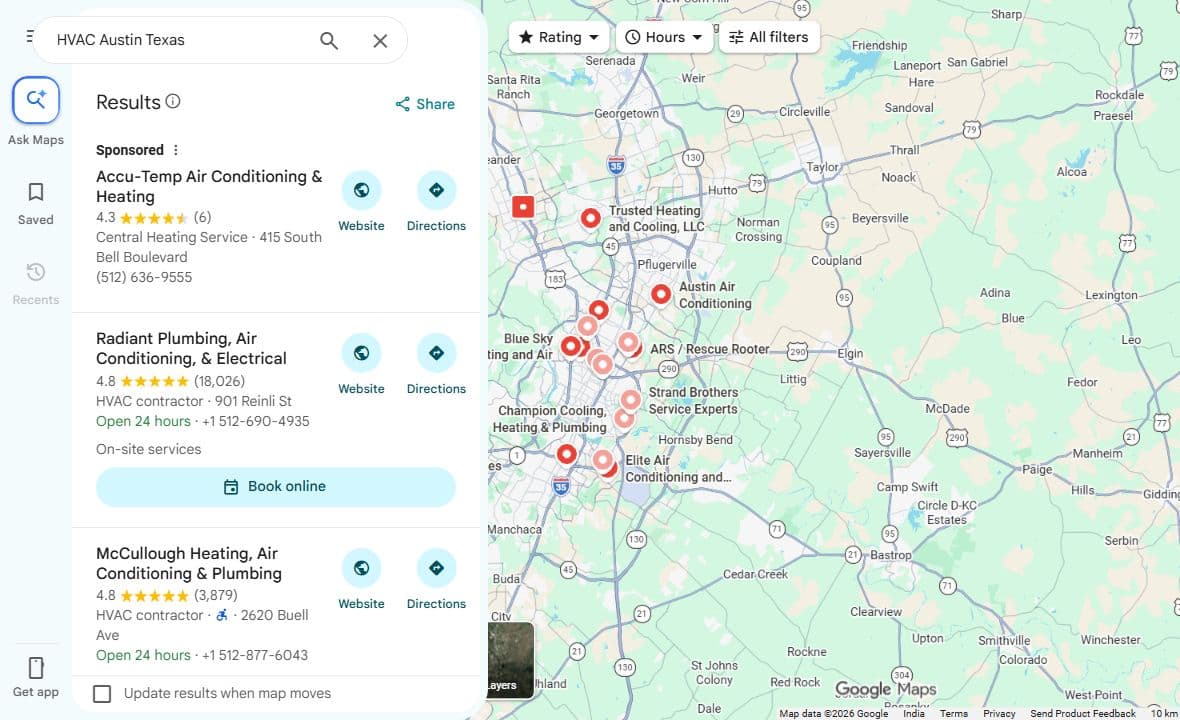
Write down the query, date, device and customer area. Compare the exact business name with a relevant service query. Label advertisements separately. One screenshot is an observation from one search context, not a citywide rank report.
Google explains local results through relevance, distance and prominence. A business can have a public profile and still appear differently for different customers. Avoid treating a competitor appearing above you once as proof that your profile is broken. If the business cannot be found by name, use our separate Google Maps visibility troubleshooting guide.
3. Check the website pages customers actually need
Open the profile's website link on your phone. Does it reach the right business and location? Can a visitor identify the service, coverage area and contact route without searching through unrelated pages?
Choose a few important service pages. Check their titles and main headings, useful descriptions, internal links and accurate contact details. A service-area page should offer real information about work in that area. Replacing a city name across dozens of otherwise identical pages is not a useful audit outcome. Record which existing page already serves each intent before proposing another article or landing page.
4. Check discovery and technical basics
With authorized Search Console access, inspect an important page and its declared canonical URL. Review indexing reasons and the sitemap. A redirect or an alternate canonical can be intentional; an excluded URL is not automatically an error.
Confirm public pages load over HTTPS and important internal links work. Keep private dashboards private. After a genuine update, Google's recrawl guidance explains the available discovery routes; a request does not guarantee immediate indexing. Record what you submitted and wait for evidence before submitting repeatedly.
If the site uses business structured data, compare its name, location, hours and other details with visible information. Follow Google's LocalBusiness documentation. Structured data is not a promise of a special search appearance or a replacement for useful content.
5. Review trust signals and information consistency
Check the main business details against its website and a small set of relevant existing listings. Investigate an old phone number or moved address before recommending a bulk listing campaign. Record the specific mismatch and who can correct it.
Review whether customers can find authentic, relevant photos and understandable responses to feedback. Keep customer privacy in mind when replying. Do not create testimonials, buy reviews or manufacture customer evidence for an audit. A provider should explain what was actually checked and what still needs the owner's access.
6. Test the path from a visit to an enquiry
Tap the phone link and check the displayed number without placing an unnecessary call. Inspect the quote or booking route. With the owner's agreement, send one clearly marked test through a controlled destination and confirm it reaches the intended team. A button click and a delivered inquiry are different outcomes.
For a first review, prioritize a broken contact route or incorrect phone number before a cosmetic title change. Keep the before-and-after evidence so the owner can verify the practical result.
Use an automated report as a starting point
The free XpertManager Local Growth Audit reviews available public business information, a small nearby comparison set and website readiness. After verification, the saved report can support a discussion about priorities. Check current availability and results on the tool itself.
It does not provide a complete website crawl, a Maps rank grid, private Business Profile management, suspension recovery or guaranteed search positions. Combine its findings with the manual checks above. If you need help assigning and implementing the work, explore local SEO and reputation support.
Turn the findings into three clear actions
For each action, write the customer problem, evidence, proposed correction, owner and verification method. An illustrative first action might be: “The profile links to an old service page; the owner will confirm the correct destination; we will verify the public link on mobile after the update.” Do not attach invented revenue or ranking gains.
Finish with a short list the business can act on, rather than a large list of unverified warnings. Review progress after the changes are live and reporting has caught up.
Good to know
- A public profile cannot reveal every private verification or restriction message. Ask the authorized owner to check the account.
- A single search screenshot is not a rank grid. Results depend on location and search context.
- Examples are illustrative, not customer results. Tools and structured data cannot guarantee indexing or rankings.
Common questions
Questions people ask
Can I do a local SEO audit for free?
Yes. You can check public business information and customer journeys with a browser and phone. Owner-authorized account checks add evidence. Define what each tool covers before treating its report as a complete audit.
Is this the same as fixing a suspended profile?
No. A suspension requires the applicable official account and appeal process. This checklist does not grant account access or resolve a restriction.
How often should I repeat these checks?
Recheck after a move, changed hours, a website release or a reported contact problem. Choose a recurring review that fits the business, and avoid repeatedly editing accurate details without evidence.
What should an agency deliver?
A dated findings worksheet with sources, limitations, prioritized actions and a verification record. Separate observed facts, illustrative examples and proposed work.